
By Lithium Cell 2024
Product Specifications: A Precisely Fitted Micro Energy Core
Product Pros and Cons: The Double-Edged Nature of Miniaturization
Equivalent Models and Alternatives: Key to Avoiding Mismatches
Technical Parameter Analysis: Performance Secrets Hidden in the Numbers
Application Scenarios: Precision Matching for Optimal Selection
The LR41 battery features a microstructure of 7.9mm in diameter and 3.6mm in height (about the size of a mung bean). It is an ideal choice for watches, calculators, and similar devices. The core parameters show significant differences:
| Parameter Type | Alkaline (LR41) | Silver Oxide (SR41) |
| Nominal Voltage | 1.5V | 1.55V |
| Typical Capacity | 25-32mAh | 35-45mAh |
| Operating Temperature | -10~60°C | -20~70°C |
Visualization Tip: If capacity is compared to a water storage container, SR41’s 45mAh is equivalent to keeping an LED mini-lamp lit for 1.5 hours, about 40% longer than LR41.
Using an anti-oxidation coating process, each unit is individually sealed to maintain a five-year standby feature. Experimental data shows that after three years in a dry 25°C environment, the SR41 voltage drops only by 0.03V (a decrease of <2%), significantly outperforming standard button cells with a 5% annual loss rate.
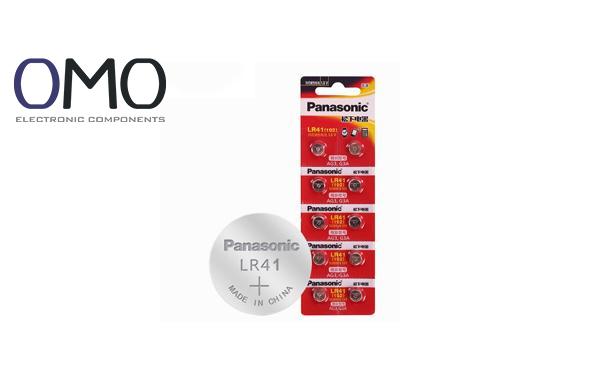
Its typical capacity of 32mAh (about 1/1000th of a smartphone battery) defines its applicable boundaries:
| Region | Equivalent Model | Voltage Compatibility |
| North America | 392 (Alkaline) / 384 (Silver Oxide) | 100% |
| Europe | LR41/SR41 | Directly Compatible |
| Japan | G3 | Slight Size Adjustment |
Note: A diameter difference of >0.2mm may cause contact failure. For example, SR44 (11.6mm) is 47% larger than LR41. Forceful replacement may damage the device.
As shown in the stepped drop trajectory, when voltage falls to 1.2V, power reliability decreases by 50%. In precision instruments such as electronic thermometers, a mandatory replacement threshold of ≥1.3V is recommended.
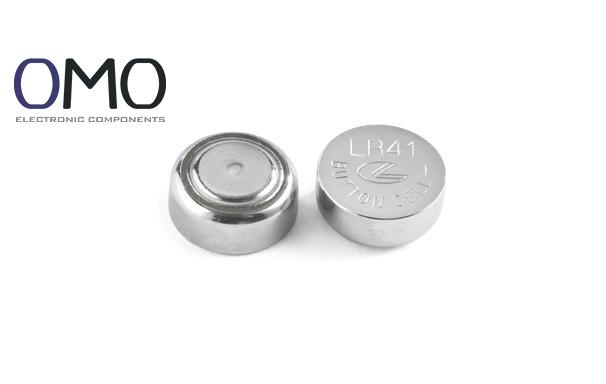
Under a 20kΩ constant-resistance discharge test:
| Scenario | Recommended Model | Advantage Demonstration |
| Medical Devices | SR41 | Measurement accuracy <0.1% error |
| Electronic Toys | LR41 | 40% cost reduction |
| Polar Exploration Equipment | Lithium Manganese CR1025 | Retains 90% capacity at -40°C |
Medical-grade models with three-proof encapsulation technology (shockproof, moisture-proof, short-circuit protection) have an outer shell 300% stronger than standard models. This ensures safety in high-frequency use devices such as ear thermometers.
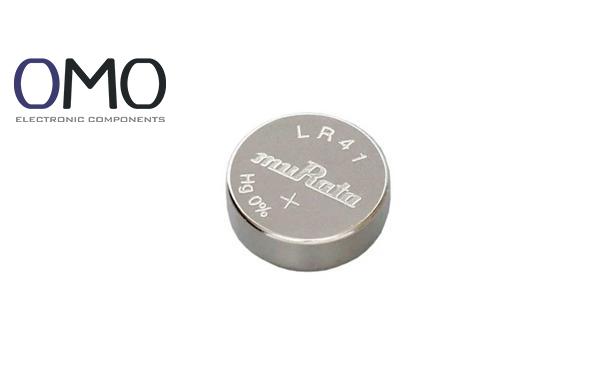
Alternative battery substitutes for the LR41 model encompass AG3, 392A, LR736, SR41, 192, and 92A. These cells share comparable dimensions and voltage specifications, enabling their use as compatible replacements in compact electronics like timepieces, calculators, hearing assistance devices, and wireless remote controls. Their standardized sizing and electrical characteristics ensure functional equivalence for power-sensitive applications.
Although LR41 and 377 batteries both fall under the category of alkaline button cells and share similar chemical properties and typical applications in compact electronics, their differing physical dimensions and technical specifications make the 377 variant unsuitable as a direct replacement for LR41 cells. While both types serve comparable functions in low-power devices like watches, calculators, and medical equipment, the dimensional disparities between these batteries prevent them from being interchangeable in most operational contexts.
The LR41 is a compact alkaline button-cell battery frequently utilized in portable electronics like wristwatches, calculators, digital thermometers, and remote control units. Operating at a nominal 1.5V, this power cell delivers an energy storage capacity of roughly 25-30 milliampere-hours (mAh).
Begin by determining which device utilizes LR41 batteries and find its battery housing. After inserting the fresh LR41 battery into the designated compartment, apply gentle pressure to ensure it's securely positioned. This procedure ensures proper and safe installation of LR41 batteries in your electronic equipment.
LR41 batteries are also known by alternative designations such as AG3, a labeling variation employed by various manufacturers or regional markets. These identifiers represent identical technical specifications and dimensional measurements, making both battery types fully compatible and functionally equivalent in devices requiring this battery type.