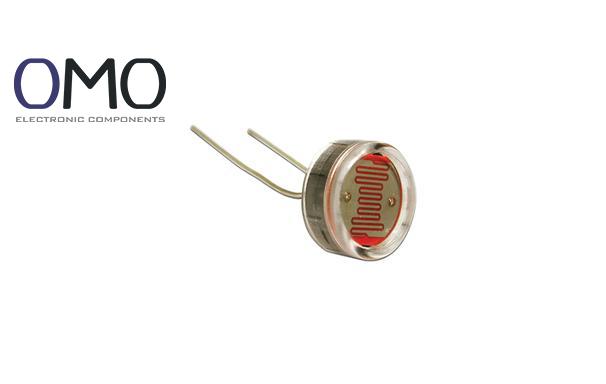
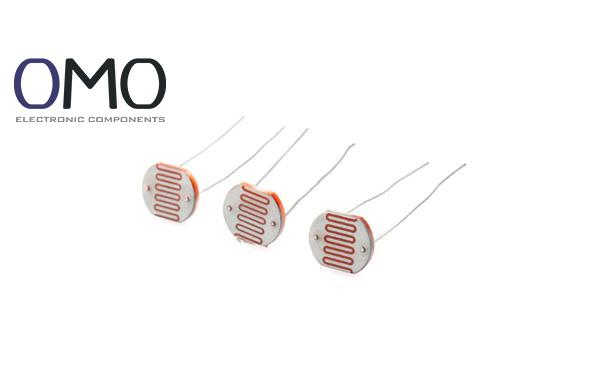
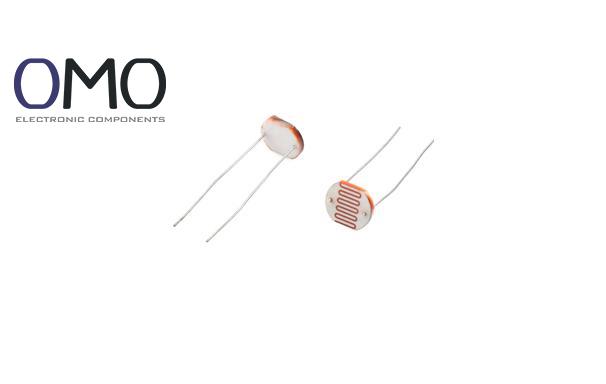
A light-dependent resistor (LDR) is a special semiconductor resistor that works by the internal photoelectric effect. Its main feature is: its resistance changes a lot depending on how much light hits its surface.
Core Principle (Internal Photoelectric Effect)
LDRs use light-sensitive semiconductor materials like cadmium sulfide (CdS) or cadmium selenide (CdSe).
When light shines on these materials, electrons inside absorb the energy of the light (photons).
If the light energy is strong enough (greater than the “bandgap” of the material), electrons jump from bound state to free state (from valence band to conduction band).
These free electrons (and holes) can move under electric fields and conduct electricity.
Inner Structure
A typical LDR has a simple but efficient design.
The light-sensitive material is placed in a zigzag pattern on a base. This pattern increases the area for light to hit.
The whole part is inside a clear case, so light can reach the sensitive layer easily.
Main light-sensitive materials:
Cadmium sulfide (CdS): Most common, low cost, responds to visible light like the human eye. But it reacts slowly (tens of milliseconds).
Cadmium selenide (CdSe): More sensitive to red and infrared light, reacts faster than CdS.
Lead sulfide (PbS): Best for infrared (IR) detection.
Germanium-doped silicon (Ge:Si) and others: For special use like IR or low-temperature systems.
Key Performance Features
LDRs have very high contrast:
In dark, resistance can reach megaohms (MΩ).
In bright light, resistance drops quickly to hundreds or thousands of ohms (Ω).
It reacts with some delay (especially CdS).
The link between light level and conductance (inverse of resistance) is non-linear (close to exponential).
Different materials react to different “colors” of light.
Light-Resistance Feature (Key Feature)
When light increases: More free charge carriers are made → resistance drops a lot.
When light decreases or disappears: Free carriers drop sharply → resistance increases a lot (up to MΩ).
This change is non-linear, but the range is huge (from a few ohms to tens of megaohms), so it is very sensitive.
Smart Applications
Thanks to being simple, cheap, and reliable, LDRs are used in many everyday and high-tech systems.
Smart Use Cases
Automatic lighting: Street or garden lights turn on/off automatically to save energy.
Security systems: When light beams are blocked, an alarm starts.
Environmental monitoring: Smoke detectors use light scattering to detect fire.
Smart brightness control: Phones or dashboards adjust screen brightness based on light.
Green energy help: Simple solar tracking systems use LDRs to find the sun.
Creative designs: Light-controlled toys or art installations.
Key Circuit – Voltage Divider
An LDR cannot give signals by itself. The most common way is using it in a voltage divider circuit with a fixed resistor:
We can connect Vout to a comparator to get a clear on/off signal, or to a microcontroller (like Arduino) to do digital processing.
Data Insight: If we draw the Vout curve, it shows a log-like rise with light.
It changes fast at low light (high sensitivity), and becomes slower at bright light.
Design Tips
Choosing the right fixed resistor R is key. It should match the LDR’s resistance in the target light range to get the best sensitivity and signal quality.
Other things to keep in mind:
Avoid stray light (use covers or filters)
Reduce temperature drift and noise (add filter circuits or software)
Set threshold voltage (Vref) carefully for correct switching.
Key Factors That Affect Performance
LDR performance depends on many things. Knowing them helps you control and improve the system.
Environmental Factors
Temperature changes: Especially affect CdS LDRs. High temperature lowers dark resistance, changes threshold, and usually has negative temperature coefficient.
Light spectrum: Different light sources have different spectra. Choose the LDR that matches it. (e.g. CdS for white light, PbS for IR).
Aging: Long-term strong light can reduce sensitivity, especially for CdS.
Moisture or corrosion: Use strong protection in harsh environments.
Material and Structure
The type of photo-sensitive material affects response speed, light range, and dark resistance.
Doping process and surface area also matter. Larger area = lower dark resistance.
The transparent window must let in enough of the right kind of light.
Pros, Limits, and How to Choose
To use LDRs well, we must know both their strengths and weaknesses.
Limitations
LDRs have some natural downsides:
Slow response (especially CdS), not good for fast tasks like data transmission.
Nonlinear light-resistance curve – needs extra work for precise use.
Sensitive to temperature and can have a “memory effect” (past light affects current state).
CdS/CdSe contain cadmium, which is not eco-friendly.
They are larger in size than other sensors.
Key Sensor Comparison Table
Feature
LDR (CdS)
Photodiode
Phototransistor
Response Speed
Slow (10–100 ms)
Very fast (nanoseconds)
Medium (microseconds)
Sensitivity (light)
Very high
Medium
High (built-in gain)
Output Type
Resistance
Current
Current
Linearity
Poor
Excellent (very linear)
Medium
Temp Stability
Poor
Good (can be corrected)
Medium
Cost
Lowest
Low to medium
Low to medium
Common Use
Light switch, alarm
Accurate light sensing, fiber optics
Optical switch, encoder
Main Strength
Cheap, simple, sensitive
Fast, linear, flexible
High sensitivity, easy use
Main Weakness
Slow, nonlinear, heat-sensitive
Needs extra parts
Limited speed and linearity
How to Use LDR in Circuits
Voltage Divider Setup
As explained earlier, the voltage divider is the core idea.
The most important thing is choosing the right fixed resistor R_fixed. It affects the working point, sensitivity, and signal-to-noise ratio.
Build a Threshold Switch
Add a comparator (like LM393) or logic gate with Schmitt trigger:
Connect Vout from LDR divider to IN+ of the comparator.
Use a potentiometer to set the threshold voltage Vref on IN-.
When Vout crosses Vref (because of light change), the output flips quickly.It can drive a relay, LED, or give a digital signal to a microcontroller.This reacts much faster than a normal mechanical switch.
MCU Smart Control
Connect Vout to an analog input (ADC) of a microcontroller (like Arduino):
Use analogRead() to get values (0–1023).
Do a threshold check (e.g., if (adcVal > threshold)).
Use a lookup table or nonlinear curve fit for better accuracy.
Add software filters (mean/median) to reduce noise.
With code, you can add more sensors or make smart logic easily.
Driving Loads
For small loads (like LEDs), the comparator or MCU can drive directly.
For bigger loads (relays, motors), use a transistor (BJT) or MOSFET as a switch.
Always add a flyback diode across relay coils to prevent damage from back EMF.
Troubleshooting and Maintenance
Common Problems
No response (always bright/dark): LDR may be broken, bad wiring, power issue, wrong R_fixed, wrong Vref, or program bug.
Slow or weak response: LDR is dirty, covered, too old, too hot/cold, or R_fixed is wrong.
Unstable signal/noise: Power ripple, long wires, flickering light, shadow, loose connection.
Overheating/smell: Serious design problem! May cause overload or short circuit. Turn off power now!
Step-by-Step Check
Look closely: Check wires, solder points, damage, and cleanliness.
Check power: Measure power voltage and see if it’s stable.
Manual test: Shine or block light on LDR. See if output (Vout or LED) changes.
Measure voltages: Check Vout, Vref, and output of comparator or MCU in light/dark.
Check resistance: Power off, use a multimeter to measure LDR resistance in light/dark.
Replace parts: Try new LDR, resistor, or IC.
Software check (ADC mode): Print ADC values to see logic and signal.
Isolate the circuit: Use a fixed resistor instead of LDR to test rest of circuit.
Maintenance Tips
Keep clean: Wipe the light-sensitive surface often. Use a clear cover with good light transmission.
Control power use: Make sure current at max light (min resistance) does not exceed LDR’s rating. Choose R_fixed carefully.
Use safe environment: Avoid heat (>70°C), cold, moisture, or corrosive areas unless using industrial type.
Prevent aging: Don’t keep LDR in strong light too long. Calibrate often for precise use.
Match light source: Choose lights that match LDR’s light range (e.g. use IR light for IR LDR).
Solder carefully: Use temperature-controlled soldering iron (<350°C, under 3 sec) to avoid heat damage.
Frequently Asked Questions
What are light dependent resistors?
The electrical resistance of a photoresistor (light dependent resistor) decreases as the intensity of light illuminating it increases.
How do light dependant resistors work?
A photoresistor operates by converting variations in light intensity into corresponding changes in its electrical resistance. Exposure to light causes the resistance to decrease, thereby permitting more current to flow.
What is a light dependent resistor used for?
Light-dependent resistors (LDRs) offer easy integration, cost-effectiveness, and inherent power-free operation for light detection. Common applications include automatic lighting and exposure control, security systems, alarms, solar energy, and others.
What is the drawback of LDR?
The simplicity and low cost of LDRs are offset by their slow response, non-linearity, and spectral limitations, rendering them unsuitable for high-performance applications.