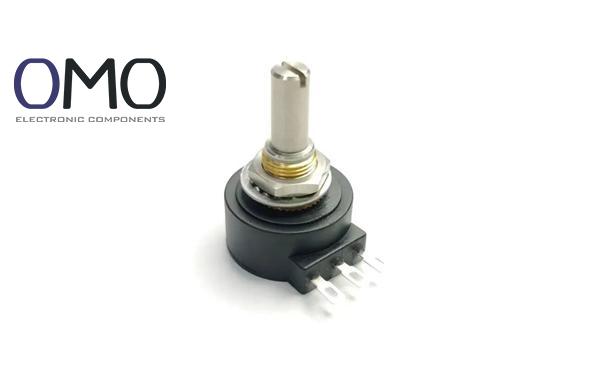
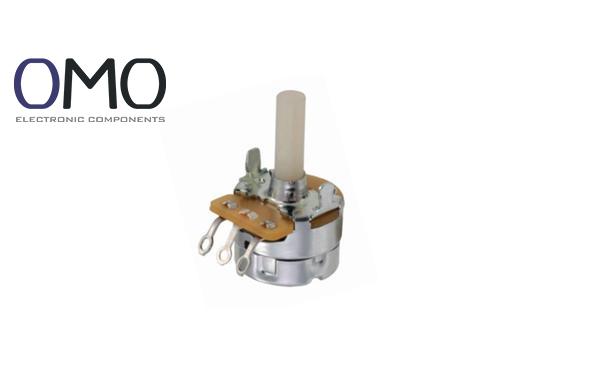
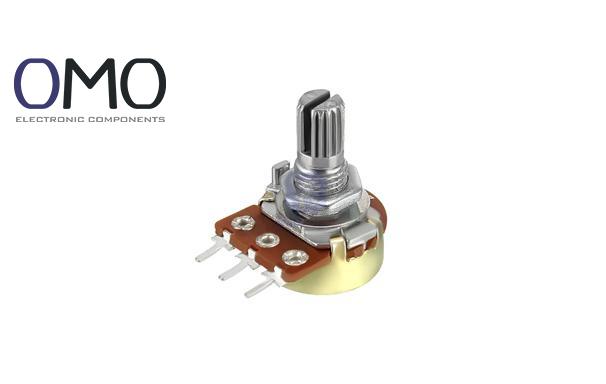
A ceramic potentiometer is a type of variable resistor that uses ceramic material as the resistive element. Its core principle lies in using a special ceramic composite made with a unique formula. The resistive track is created by a thick-film printing process, allowing precise and stable adjustment of resistance values.
Compared with traditional carbon film or metal film potentiometers, ceramic potentiometers use different materials and manufacturing methods, which directly result in their superior performance.
Key Features
The uniqueness of ceramic potentiometers comes from their material and production process. Their main features include:
High Stability: Very small drift of resistance value with temperature, time, and environment. The Temperature Coefficient of Resistance (TCR) can be as low as ±100 ppm/°C in the range of -55 °C to +125 °C.
High Power Handling: Can handle more power than normal potentiometers. The rated power usually reaches 2 W – 5 W, or even higher.
Excellent Pulse Resistance: Can withstand short, high current or voltage pulses up to 5–10 times the rated power.
Low Noise: The electrical noise generated by the wiper (sliding contact) is low, with contact resistance variation usually less than 2%.
Long Life and High Reliability: Ceramic materials are wear- and corrosion-resistant, giving a mechanical life of over 100,000 rotations.
Key Components
Each component in a ceramic potentiometer plays a crucial role:
Ceramic Substrate: The base for the resistive track, usually made of alumina (Al₂O₃) with a purity above 96%. It provides mechanical support, insulation, and high thermal conductivity (20–30 W/(m·K)).
Thick-Film Resistive Paste: A mixture of metal oxides, glass powder, and organic binder. It is applied by screen printing on the substrate and sintered at 800–1000 °C to form a strong resistive layer.
Wiper (Brush): Usually made of precious metal alloy, it moves smoothly on the resistive track to change resistance. The contact pressure is precisely designed to ensure stable performance and low wear.
Shaft and Terminals: The shaft controls the wiper’s position. The terminals are made of solderable metals for reliable circuit connection.
Housing and Structural Parts: Protect the inner parts from dust, moisture, and mechanical damage, and provide mounting options.
Working Principle of Ceramic Potentiometers
Ceramic potentiometers work based on the voltage divider principle.
They usually have three terminals: two fixed terminals (1 and 3) and one movable wiper terminal (2). When a voltage is applied between the fixed terminals, a uniform voltage gradient forms along the resistive track.
By rotating or sliding the wiper, the resistance between the wiper and each fixed terminal changes. This adjusts the output voltage, which depends on the wiper’s position. The linearity of this relationship is typically within ±10%.
Because the resistive track is made of thick-film ceramic material, it provides a uniform resistance distribution and stable electrical performance, ensuring precise voltage division and durability, even under high load or harsh conditions.
Core Advantages and Unique Performance
Main Advantages
The biggest strengths of ceramic potentiometers are high power density and excellent environmental stability.
They can handle 3–5 times more power than carbon film potentiometers of the same size, which is ideal for space-limited designs. They also resist humidity, temperature variation, and chemical corrosion, working reliably from -55 °C to +125 °C.
Advantages from Ceramic Material
High Thermal Conductivity: The ceramic substrate quickly spreads the heat from the resistive track (20–35 W/(m·K)), preventing hot spots.
High Hardness and Wear Resistance: The ceramic layer has a Vickers hardness up to 1500 HV, reducing wear from the wiper and extending lifespan.
Excellent Insulation: The volume resistivity exceeds 10¹² Ω·cm, ensuring good electrical isolation.
Chemical Inertness: The ceramic material resists oxidation and moisture; performance remains stable even at 85 °C and 85% RH.
Comparison with Carbon Film Potentiometers
Parameter
Ceramic Potentiometer
Carbon Film Potentiometer
Winner
Rated Power
High (2–5 W, up to 10 W for special models)
Low (0.25–0.5 W)
Ceramic
Pulse Resistance
Excellent (5–10× rated power)
Limited
Ceramic
Stability & Lifetime
Excellent (>100k cycles, ±3%)
Moderate (10–20k cycles)
Ceramic
Temperature Coefficient
Low (±100 – ±250 ppm/°C)
High (±300 – ±1000 ppm/°C)
Ceramic
Cost
Higher (30–100% more expensive)
Lower
Carbon
Adjustment Smoothness
Good (±5 – ±10%)
Average (±10 – ±20%)
Depends
Ceramic potentiometers clearly outperform carbon types in power handling, stability, and lifespan, making them ideal for demanding industrial uses.
Limitations
Despite their advantages, ceramic potentiometers have some drawbacks:
Higher Cost due to material and manufacturing complexity
Less Smooth Adjustment Feel compared to conductive plastic types
Limited Resolution in certain power models, making them unsuitable for ultra-precise control applications
Types of Ceramic Potentiometers
By Adjustment Method
Rotary Type: The most common type. It uses a rotating shaft, usually 270°–300°, or multi-turn designs. Ideal for panel mounting and frequent adjustments.
Linear (Slide) Type: Adjusted by sliding in a straight line (20–60 mm travel). Common in audio and user interface devices because the position directly represents the resistance value.
By Function
Power Type: Designed for high power handling, rated above 2 W, often used in power supplies, motor control, and power distribution.
Trimming (Semi-fixed) Type: Small-sized, used for once-only calibration or fine-tuning on circuit boards. Often sealed after adjustment.
Precision Type: Offers high linearity (±1%), low noise, and long life, used in measurement instruments and control systems.
Application Fields
Ceramic potentiometers are used in many demanding areas due to their performance:
Industrial Control and Automation:
Motor speed control
Power controllers for precise load distribution
Industrial power supplies for voltage/current adjustment
Process control systems operating in harsh environments
Automotive Electronics:
Body control modules (windows, seats, etc.)
Sensor signal calibration
Power management and battery monitoring
Engine control unit (ECU) parameter setting
Medical Equipment:
Power systems in diagnostic/treatment devices
Control circuits in MRI and CT systems
Adjustable hospital beds and wheelchairs
Life-support systems requiring extreme reliability
Test and Measurement Equipment:
Laboratory power supplies
Calibration devices
Data acquisition systems
RF and baseband test instruments
High-end Consumer Electronics:
Hi-Fi audio systems for low-noise tone and volume control
Large appliances (washing machines, air conditioners)
Professional audio mixers and recorders
High-power LED lighting brightness control
Ceramic Potentiometers and Hybrid Potentiometers
In potentiometer technology, a ceramic potentiometer refers to one with a pure ceramic thick-film resistive track.
A hybrid potentiometer, however, combines different materials and technologies.
A typical example is the Cermet Potentiometer (Ceramic-Metal Potentiometer) — its name comes from Ceramic + Metal. It uses a metal-ceramic resistive paste on a ceramic substrate, combining ceramic stability and metal conductivity. Therefore, Cermet potentiometers are a key subcategory of ceramic potentiometers and share many of their advantages.
From a technical evolution viewpoint, potentiometers can be grouped as:
Carbon Film / Metal Film Potentiometers – low cost, limited performance
Ceramic-Based Potentiometers – balanced performance and cost
Conductive Plastic / Precious Metal Potentiometers – ultra-high precision and long life
In practice, about 75% of industrial potentiometer applications benefit from ceramic or Cermet types, especially when power handling, stability, and durability are crucial.
Frequently Asked Questions
What are the three types of potentiometers?
Potentiometers are variable resistors available in multiple forms, distinguished by factors such as design, material composition, and application. The primary classifications include linear, rotary, and digital potentiometers.
What are ceramic potentiometers?
A ceramic potentiometer is an adjustable electronic component composed of a ceramic-based resistive track. This track is typically formulated with conductive additives to create a precise resistance gradient.
What materials are used in ceramic potentiometers?
The resistive element in a ceramic potentiometer can be fabricated from various materials, including carbon, wire (as in wirewound types), film, or cermet—a composite of ceramic and metal. This element is typically used in conjunction with conductive additives and metal contacts.
How does ceramic potentiometers differ from standard potentiometers?
Compared to standard potentiometers like carbon film or conductive plastic types, ceramic potentiometers employ ceramic resistance elements that offer greater stability and can operate at temperatures as high as 200°C. Standard versions, while more economical, have limited tolerance to high temperatures.