
By Rectifier Diode 1228
Core Characteristics and Parameters of Rectifier Diodes
Functional Role of Rectifier Diodes
Types and Application Selection
Differences Between Rectifier and Signal Diodes
Selection Guide for Rectifier Diodes
A rectifier diode is a semiconductor device used to convert alternating current (AC) into direct current (DC).
It is one of the most basic and important components in electronic circuits.
It is widely used in power adapters, chargers, and industrial power supplies.
Its main value is to provide stable DC power for modern electronic devices by efficiently and reliably converting AC to DC.
The working principle of a rectifier diode is based on the one-way conductivity of a PN junction.
When a P-type and an N-type semiconductor join, they form a depletion layer (also called a space charge region).
This layer allows current to flow only in one direction.
When the P region has a higher voltage than the N region, the depletion layer becomes thinner and the diode conducts.
When the N region has a higher voltage, the depletion layer becomes wider and the diode stops conducting.
In circuit diagrams, the rectifier diode is shown as a triangle pointing toward a short vertical line.
The triangle side represents the anode (P region), and the short line side represents the cathode (N region).
The arrow direction shows the forward current (from anode to cathode).
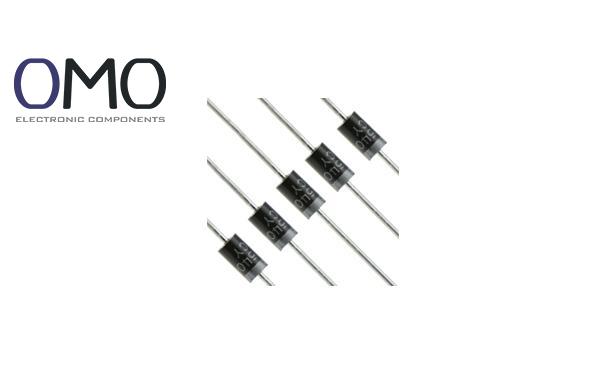
| Parameter Name | Definition | Typical Range | Influence |
| Maximum Average Rectified Current (IF(AV)) | Maximum forward average current during continuous operation | 1A–50A | Determines power handling |
| Maximum Reverse Repetitive Voltage (VRRM) | Maximum reverse voltage without breakdown | 50V–1000V | Determines voltage tolerance |
| Forward Voltage Drop (VF) | Voltage drop when conducting | 0.7V–1.2V (silicon) | Affects efficiency and heating |
| Reverse Recovery Time (trr) | Time from conducting to full cutoff | Nanoseconds to microseconds | Limits operating frequency |
| Maximum Surge Current (IFSM) | Short-time overload current | Tens to hundreds of amperes | Affects surge resistance |
Data visualization note:
If we plot the relationship between forward voltage drop and maximum rectified current for different diode models, we can see a clear negative trend — higher current models usually have lower VF.
This helps reduce power loss in high-current circuits.
When engineers select rectifier diodes, they must balance several factors:
Example 1:
In a switching power supply, replacing a standard 1N4007 diode (trr ≈ 30 µs) with an ES1J ultra-fast diode (trr = 35 ns) can reduce switching loss by up to 70%.
Although the price increases by about 40%, system efficiency improves greatly.
The operating frequency of a rectifier diode is limited mainly by reverse recovery time (trr).
At high frequencies, long trr causes:
Recommended types by frequency:
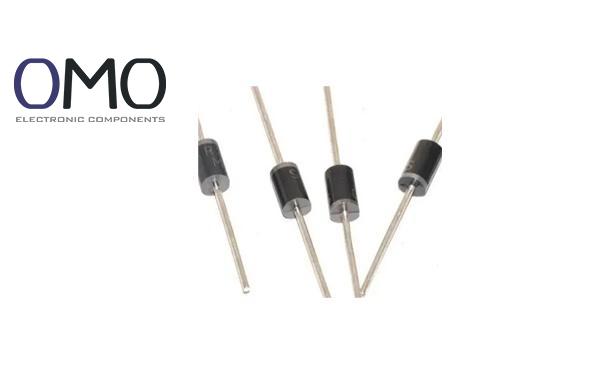
The main function is rectification, converting AC (two-way current) into DC (one-way current).
Data visualization note:
Comparing half-wave and full-wave output waveforms shows that full-wave rectification doubles the ripple frequency and average output voltage while reducing ripple factor.
Used in low-frequency (50/60 Hz) applications.
Features:
Typical uses: Power adapters, home appliances.
Designed for high-frequency use.
Features:
Typical uses: Switching Mode Power Supply (SMPS), inverters.
Example 2:
In a solar inverter, replacing a normal fast diode with an ultra-fast diode (FFPF10H60S, trr = 35 ns) increased system efficiency from 96.5% to 98.2% and reduced heatsink size by 30%.
Although diode cost rose by 25%, total system cost decreased.
Based on a metal–semiconductor junction.
Advantages:
Disadvantages:
Typical uses: Low-voltage, high-current, and high-frequency rectification.
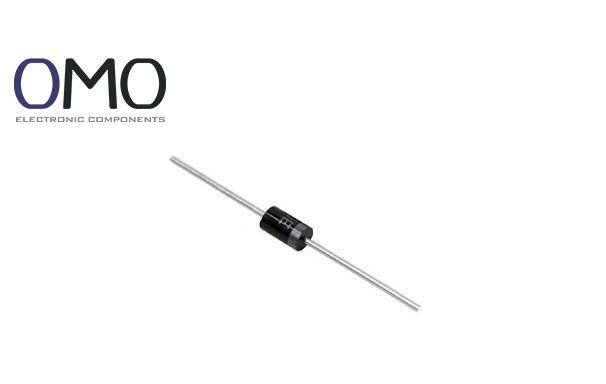
| Fault Type | Symptom | Test Method | Possible Cause |
| Open circuit | No output, load not working | Infinite forward resistance | Overcurrent or physical damage |
| Short circuit | Fuse blows, circuit overheats | Both directions ≈ 0 Ω | Overvoltage breakdown or overheating |
| Performance degradation | Lower efficiency, more heating | Higher VF | Long-term overload or aging |
Data visualization note:
Among 1000 diode failures, short circuits made up 55%, open circuits 35%, and degradation 10%.
Of short circuits, 60% were due to overvoltage and 40% to overheating.
| Characteristic | Rectifier Diode | Small Signal Diode |
| Max rectified current | > 1A, up to tens of amperes | < 100 mA |
| Reverse breakdown voltage | 50V–1000V+ | < 100V |
| Forward voltage drop | 0.7V–1.2V | 0.6V–1.0V |
| Switching speed | Slow (standard), faster for recovery types | Usually fast |
| Size | Large, often with heatsink | Small package |
| Main use | Power rectification and conversion | Signal processing, protection |
Example 3:
In car alternator systems, automotive-grade diode modules (e.g., Vishay VS series) cost 20% more than industrial ones, but their operating range is –40 °C to +175 °C, and failure rate is five times lower, improving reliability.
| Model Series | Max Average Current | Peak Reverse Voltage | Features and Uses |
| 1N4001–1N4007 | 1A | 50V–1000V | General purpose, low cost |
| 1N5400–1N5408 | 3A | 50V–1000V | Medium power |
| FR Series (Fast Recovery) | 1A–10A | 50V–1000V | SMPS, inverter |
| MUR Series (Ultra-Fast Recovery) | 1A–20A | 200V–1000V | High-frequency circuits |
A rectifier bridge integrates four diodes into one package to simplify design and assembly.
Features: easy installation, compact size, higher reliability.
The principal function of a rectifier diode, a semiconductor component, is to conduct electrical current in one direction and block it under reverse bias. This property is essential for the rectification process, which converts AC to DC.
To measure the forward voltage, place the red probe on the anode and the black probe on the cathode. A functioning diode typically exhibits a voltage drop between 0.6V and 0.7V. Next, switch the probes to test the reverse voltage; a properly working diode should read "OL" or infinity, showing that no current flows in this direction.
Rectifier diodes are used to convert alternating current (AC) into direct current (DC). They are capable of handling high current and voltage levels, though their switching speed is relatively slow. These diodes are commonly employed in power supply circuits and motor control systems.In contrast, switching diodes are designed for high-frequency operations, offering fast switching speeds and low capacitance. They are typically utilized in high-frequency applications.
A rectifier diode ensures unidirectional current flow in a circuit. It becomes forward-biased and conducts in the positive half-cycle of AC, while being reverse-biased to block current in the negative half-cycle. This action transforms AC into DC.